One bottle, four stores
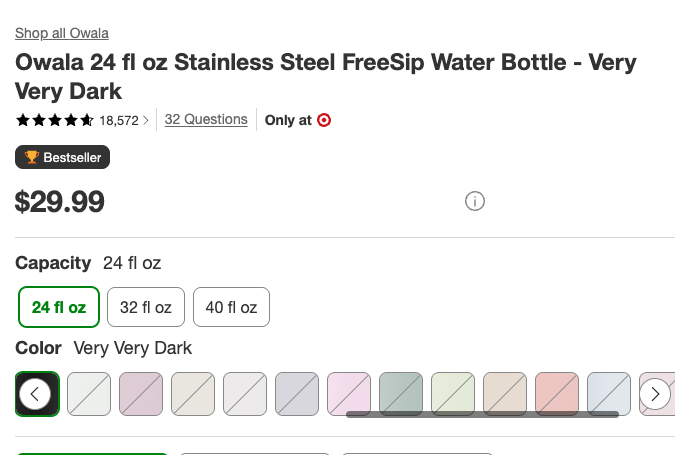
We expected this to be a boring run. The Owala FreeSip 24 oz costs $29.99 on Owala’s own site and $29.99 at Target, and if you were checking by hand you’d probably write that down and go get lunch.
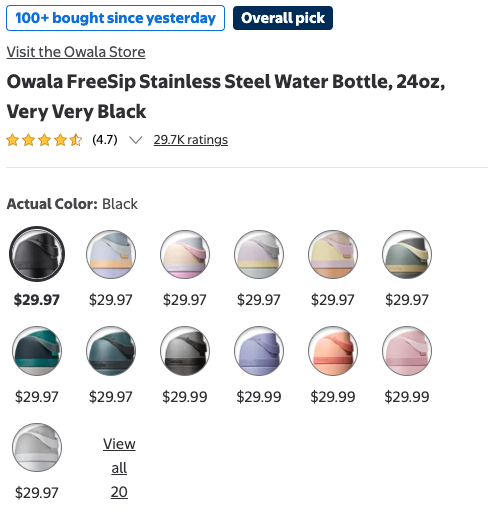
Walmart had a small oddity: $29.97 for the core colors, $29.99 for the rest. We still don’t know why the two-cent split exists (a promotion on a few SKUs, or some pricing rule nobody at Walmart remembers setting), and dassi didn’t guess either. It wrote down both prices and which colors carried them.
Amazon was messier. The 24 oz listing holds more than 70 colorways, and the retired or hard-to-find ones come from third-party sellers at $39.99, $49.67 and $61.99. Owala, meanwhile, had sold out of several colors, Very, Very Dark and Off the Grid among them.
If you sell something like this bottle, that’s the stuff you’re watching for. An undercut can hide in a single variant. And the $61.99 listing is a reseller, so calling it “the Amazon price” would give you a strange idea of the market.
The run itself
One real dassi run, recorded on September 19, 2026, from a test browser profile in Chrome on a Mac. Public product pages only, and it changed nothing. The instruction was typed in plain English: check this bottle at four retailers, read-only, give me a table, flag anything inconsistent, summarize, show your steps. It finished in 4 minutes 57 seconds.
On owalalife.com it searched, opened the FreeSip, picked 24 oz and clicked through the colors for price and stock. On Amazon it opened listing B0BZYCJK89 and went through the variations and their sellers. Target and Walmart took a search and a product page each. Every row in the table carries the URL it was read from.
Making it a Monday thing
A single check tells you about one morning. For a small store the useful version is probably a short list (a dozen SKUs, a few competitors, whichever marketplaces your product gets resold on) checked every week without anyone having to remember.
You teach the job once: products, stores, the columns in your sheet, and which changes deserve a flag. Save it as a workflow and give it a schedule. On Monday morning dassi goes through the same pages in your browser and appends a dated block of rows to your Google Sheet, with anything that crossed a line you drew marked at the top. The browser has to be open when the run is due, because that’s where the run happens.
Your own prices stay where they are. Lowering a Shopify price when a competitor goes under yours would be a separate action, and if you add it, you mark it for approval and dassi asks before every save.
Limits worth knowing
dassi sees what the page shows your browser. Member pricing, coupons and ZIP-based prices will reflect your session and your location, which is mostly what you want, although two people on the same team can get different numbers and both be right.
It reads one page and then the next, the way a person would. Fine for a weekly watch list of a few dozen listings. Crawling a whole category is another matter, and Amazon and the other big retailers restrict that kind of bulk collection in their terms anyway. If you need ten thousand SKUs tracked every hour, buy a data feed. We’d be the wrong tool.